





High Performance Inference on your Mac
Marathon serves open models on M5 chips faster than mlx-lm, vllm-metal and llama.cpp. Run for free, forever.
Free inference
Every token runs on your own hardware.
Your data stays on your device
Prompts and outputs never leave your Mac.
Faster than anything else
Ahead of mlx-lm, vllm-metal and llama.cpp on every model we benchmarked.
Benchmarked on an M5 Max
Peak gains over the fastest alternative for each test.
- 2.7×
- Faster decode at 32k context
- Peak gain, vs vllm-metal on Gemma 4 26B-A4B
- 2.3×
- More throughput across 8 streams
- Peak gain, vs mlx_lm.server on Gemma 4 E2B
- 4.4×
- More throughput on shared prompts
- Peak gain, vs mlx_lm.server on Qwen3.8-27B
Chat, code, or anything else.
Welcome to Marathon
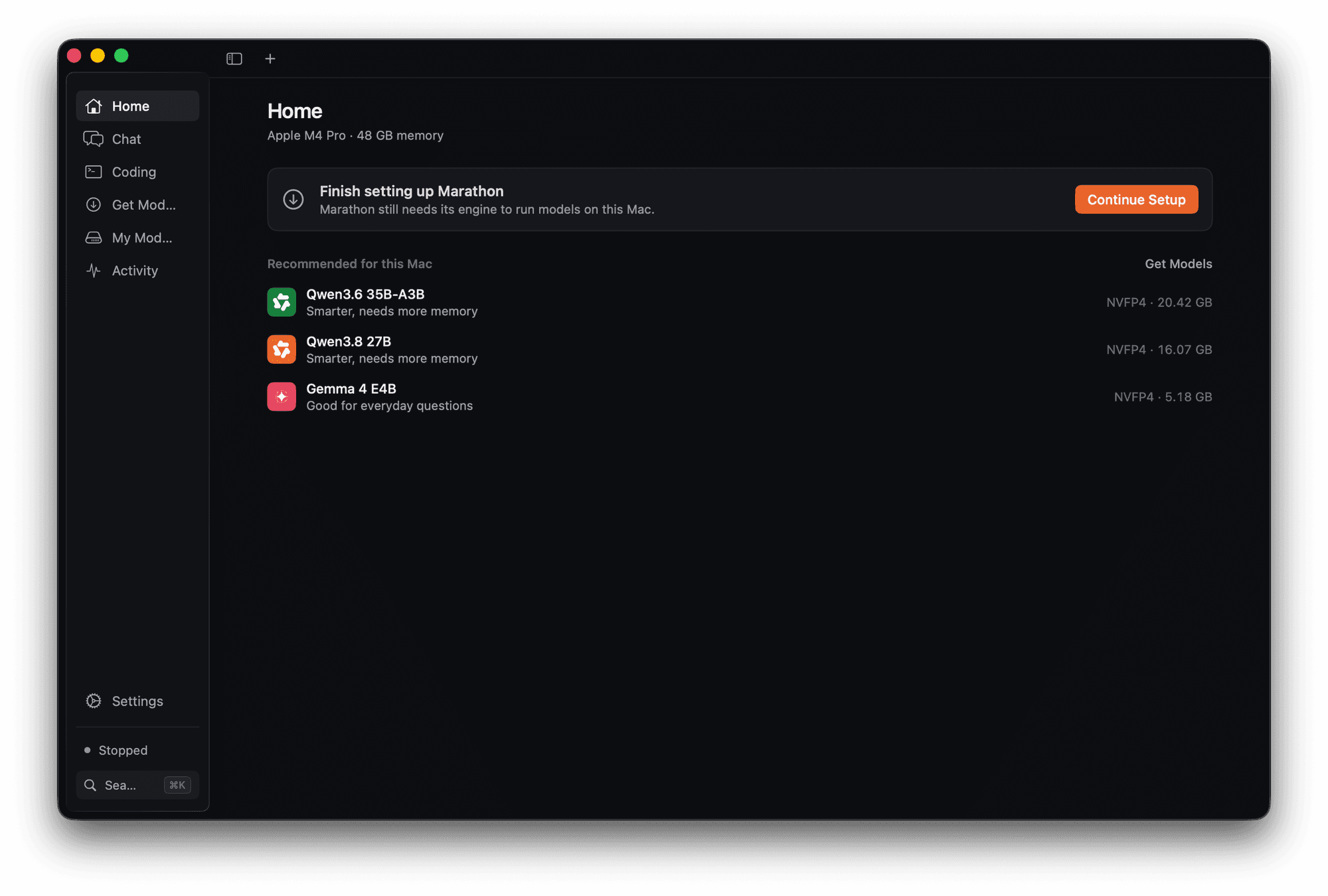
Download any open model
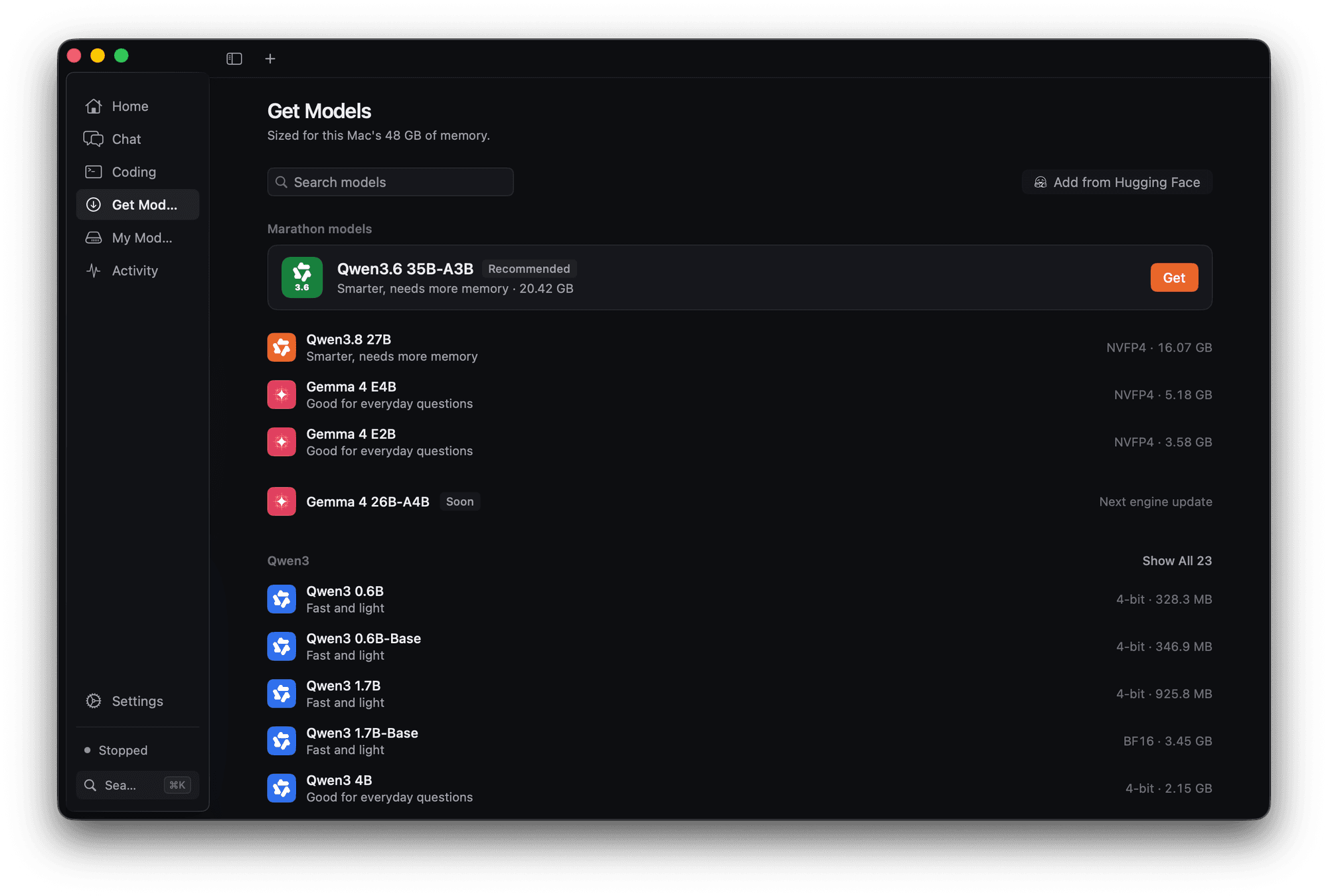
Run coding agents directly in the app
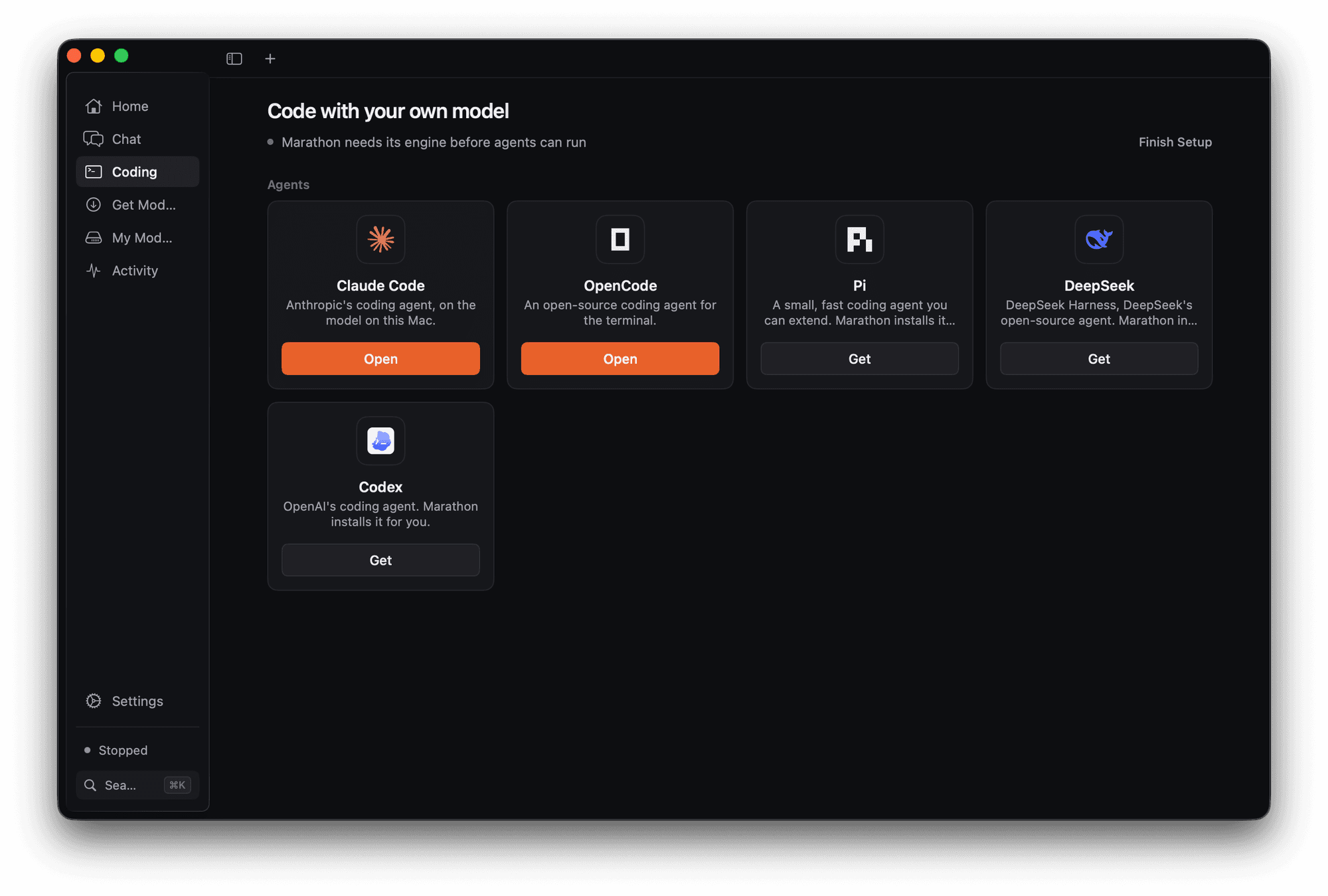
Get started.
- 01
- 02
Download open‑weight models
Pick Inkling, Gemma or Qwen from the app.
- 03
Run inference locally
Free, on your Mac, for as long as you like.
Faster on every benchmark.
Marathon Local vs mlx-lm, vllm-metal and llama.cpp, running the same models on the same Mac (Apple M5 Max, 36 GB).
One stream decoding behind a 32k-token prompt. Higher is better.
Gemma 4 26B-A4B
1.4× vs next best- Marathon94.7 tok/s
- mlx-lm68.5 tok/s
- vllm-metal34.8 tok/s
- llama.cpp60 tok/s
Gemma 4 E4B
1.2× vs next best- Marathon88.3 tok/s
- mlx-lm63.6 tok/s
- vllm-metal47.6 tok/s
- llama.cpp71.8 tok/s
Gemma 4 E2B
1.1× vs next best- Marathon145 tok/s
- mlx-lm128 tok/s
- vllm-metal59.3 tok/s
- llama.cpp108 tok/s
Qwen3.8-27B + MTP
1.3× vs next best- Marathon41.7 tok/s
- mlx-lmOOM
- vllm-metal20.5 tok/s
- llama.cpp31.5 tok/s
Qwen3.6-35B-A3B + MTP
1.5× vs next best- Marathon127 tok/s
- mlx-lm85.5 tok/s
- vllm-metal77.8 tok/s
- llama.cpp77.2 tok/s
MLX 0.32.4, mlx-lm 0.32.3 (mlx_lm.server), vllm-metal 0.33.0, llama.cpp cf4153a9b (llama-server). Measured 2026-11-09 to 2026-11-20. llama.cpp runs the 4-bit GGUF closest to each nvfp4 checkpoint. mlx_lm.server ran out of GPU memory on Qwen3.8-27B’s 32k prompt, twice. mlx_lm.server slows past four streams; run in process, mlx-lm is closer on the small Gemma models.
Models you can run today.
Each model is tested to give excellent performance and efficiency on Marathon.
- Inkling 2 MiniText, images
- Gemma 4 26B-A4BText, images
- Gemma 4 E4BText, images, audio
- Gemma 4 E2BText, images, audio
- Qwen3.8-27BText
- Qwen3.6-35B-A3BText
- Qwen3.5-27BText
- Qwen3.5-0.8BText, images
- Qwen3-0.6BText
Different neural architectures.
Inkling, Gemma and Qwen supported.
| Attention architecture | Residual connection | Model families |
|---|---|---|
| Looped sliding-window attention + GQA with attention sinks | Block attention residuals (depth attention over earlier blocks’ outputs) | Inkling 2 Mini |
| Sliding-window attention + GQA, shared KV | Sandwich-norm residual (RMSNorm before and after each sublayer, with a per-layer scalar) | Gemma 4 |
| Gated DeltaNet + gated GQA | Pre-norm residual | Qwen3.8, Qwen3.6, Qwen3.5 |
| GQA | Pre-norm residual | Qwen3 |
Questions
- On one Apple M5 Max with 36 GB, one server at a time, between 2026-11-09 and 2026-11-20. Against MLX 0.32.4 with mlx-lm 0.32.3 (mlx_lm.server), vllm-metal 0.33.0 and llama.cpp cf4153a9b (llama-server). Marathon and mlx-lm run the nvfp4 checkpoints; llama.cpp runs the 4-bit GGUF closest to each one.
- Speculative decoding with the model’s multi-token prediction head: the head drafts the next tokens and the model checks them in one step. mlx-lm and vllm-metal cannot use an MTP head on these hybrid models, so their numbers are their ordinary runs. llama.cpp drafts with the GGUF’s own MTP layer.
- Rarely. Qwen3-0.6B at 8 streams is level with vllm-metal (1.0×). Against mlx-lm run in process rather than through its server, mlx-lm is 3–5% faster on Gemma 4 E2B and E4B up to four streams; Marathon pulls ahead from eight.
- Yes. Install it with one command and run open models on your Mac.
Outgrown one Mac?
The same team runs Marathon Mode in the cloud, for agent sessions past 200k tokens.